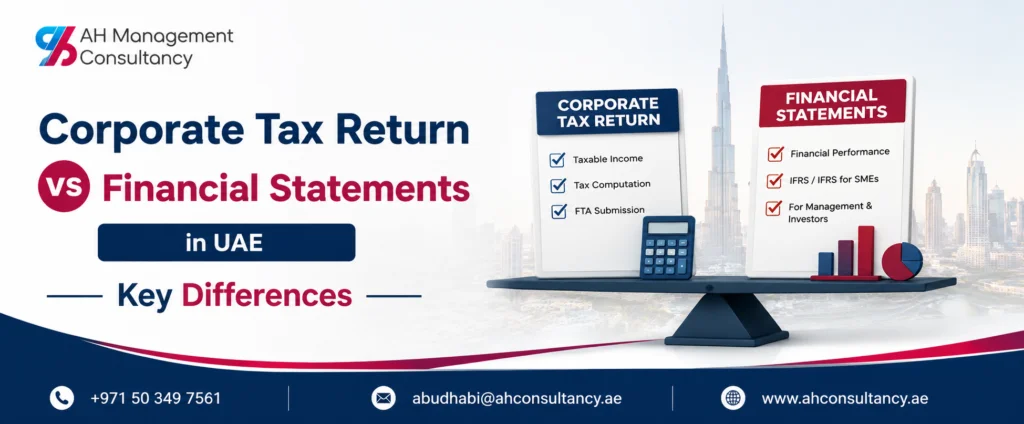
If you operate a business in the UAE, understanding the difference between a Corporate Tax Return and Financial Statements is essential for complying with the Federal Tax Authority (FTA). Although these terms are closely related, they serve different purposes. Financial statements present your company’s financial performance during a financial year, while a corporate tax return determines the amount of corporate tax your business must pay under the UAE Corporate Tax Law.
Many businesses assume that preparing financial statements is sufficient for corporate tax compliance. However, a corporate tax return requires additional tax adjustments based on UAE tax regulations. Understanding the distinction between these documents helps businesses avoid compliance issues, reduce filing errors, and meet tax deadlines with confidence.
What Is a Corporate Tax Return?
A Corporate Tax Return is an official document submitted to the Federal Tax Authority (FTA) after the end of a financial year. It reports a company’s taxable income and calculates the corporate tax payable in accordance with the UAE Corporate Tax Law.
The return is prepared using the company’s accounting records and financial statements. It also includes tax-specific adjustments, such as non-deductible expenses, exempt income, tax losses, and other items required under the law. Once completed, the return must be filed through the FTA’s online portal within the applicable filing deadline.
Submitting an accurate corporate tax return is essential because incorrect or incomplete information may result in penalties, additional tax assessments, or compliance issues.
What Are Financial Statements?
Financial Statements are accounting reports that present the financial position and financial performance of a business over a specific accounting period. They are generally prepared in accordance with International Financial Reporting Standards (IFRS) or IFRS for SMEs.
A complete set of financial statements typically includes the Balance Sheet, Statement of Profit or Loss, Cash Flow Statement, Statement of Changes in Equity, and Notes to the Financial Statements.
These reports provide valuable financial information to business owners, investors, lenders, auditors, and management. They also serve as the primary source of information used to prepare a corporate tax return.
Corporate Tax Return vs. Financial Statements
Although both documents are prepared using the same accounting records, they have different objectives.

In simple terms, financial statements explain how a business performed during the financial year, while a corporate tax return calculates the tax payable based on UAE tax regulations.
Why Financial Statements Are Important for Corporate Tax
Financial statements form the foundation of every corporate tax return. Without accurate accounting records, businesses cannot determine their taxable income correctly.
Well-prepared financial statements provide reliable information about revenue, expenses, assets, liabilities, and net profit. This information is then reviewed and adjusted according to the UAE Corporate Tax Law to arrive at the final taxable income.
Maintaining accurate financial statements also improves financial transparency, supports better business planning, and provides the necessary documentation if the FTA conducts a tax audit or compliance review.
Why Accounting Profit and Taxable Profit Are Different
A common misconception among business owners is that accounting profit and taxable profit are always the same. In reality, they often differ.
Accounting profit is calculated according to IFRS, while taxable profit is determined based on the provisions of the UAE Corporate Tax Law. Certain expenses recorded in the financial statements may not be tax deductible, and some types of income may qualify for exemptions.
As a result, businesses must make specific tax adjustments before calculating the final taxable income reported in the corporate tax return.
Common Mistakes Businesses Make
Many businesses face compliance issues because they:
- File corporate tax returns without maintaining accurate bookkeeping.
- Claim expenses that are not tax deductible.
- Miss corporate tax filing deadlines.
- Maintain incomplete or inaccurate financial records.
Working with experienced accounting and corporate tax professionals can help businesses avoid these common mistakes and ensure compliance with UAE tax regulations.
Best Practices for UAE Businesses
Businesses should maintain accurate accounting records throughout the financial year instead of waiting until the filing deadline. Regular bookkeeping, bank reconciliations, and timely preparation of financial statements make corporate tax filing more efficient and accurate.
It is equally important to retain invoices, contracts, payroll records, bank statements, and other supporting documents. These records provide evidence during audits and help businesses demonstrate compliance with the Federal Tax Authority’s requirements.
Seeking professional accounting and corporate tax advice can further improve accuracy, reduce compliance risks, and ensure that all tax obligations are met on time.
Final Thought
Although Corporate Tax Returns and Financial Statements are closely connected, they are not the same. Financial statements present a company’s financial performance and position, while a corporate tax return applies UAE Corporate Tax regulations to calculate the amount of tax payable.
Businesses that maintain accurate accounting records and prepare reliable financial statements are better positioned to meet their corporate tax obligations, avoid penalties, and make informed financial decisions. Understanding the difference between these two documents is an important step toward maintaining compliance and supporting long-term business growth in the UAE.